
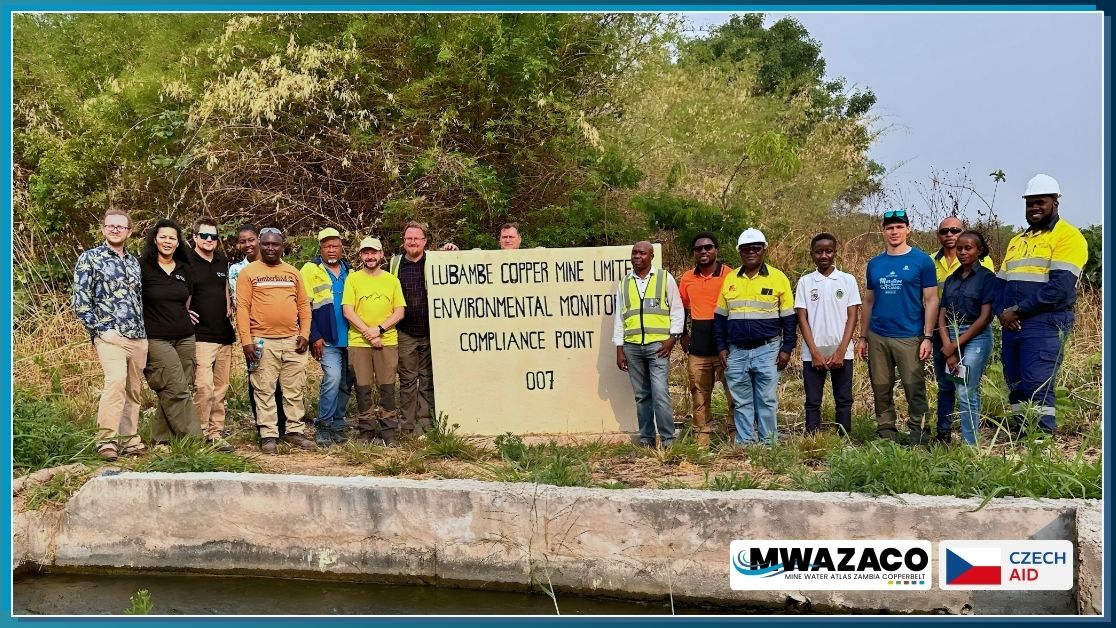
In 2025, the MWAZACO project completed its first year of implementation in Zambia’s Copperbelt Province, laying the institutional, analytical and technical foundations for long-term improvements in mine water management.
Supported by the Czech Development Agency, MWAZACO was designed as a multi-year initiative. Rather than focusing immediately on construction or technical installation, the first year concentrated on establishing cooperation structures, building data systems, and initiating field assessments necessary for responsible, evidence-based intervention planning.
Establishing Governance and Strategic Direction
The year began with the formal establishment of the project’s governance framework. Advisory and decision-making bodies were established to ensure structured coordination among Zambian institutions, academic partners, and Czech development stakeholders.
The official launch at Copperbelt University brought together representatives from the Mines Safety Department (MSD), the Zambia Environmental Management Agency (ZEMA), the Water Resources Management Authority (WARMA), academic institutions, and development partners. This early alignment ensured that the project’s objectives, responsibilities and implementation approach were clearly defined from the outset.
Strong institutional cooperation became a cornerstone of the project’s first year.
Creating a Reliable Environmental Data Baseline
A major focus of 2025 was the compilation and review of historical environmental and hydrochemical data related to mine water discharge.
Using long-term research data from previous environmental studies in the region, the project team created structured preliminary databases documenting known discharge locations, water quality parameters and potentially affected communities and ecosystems.
This analytical baseline confirmed that in several parts of the Kafue River basin, mine water discharge has a locally significant, and in some cases, significant influence on water quality. Identifying these patterns was essential before moving toward intervention design.
Moving from Analysis to Field Verification
Building on archival research, the project launched its first field campaigns across selected locations in the Copperbelt. Water and sediment samples were collected, and hydrochemical measurements were carried out directly in the field.
Preliminary results revealed considerable variability in water quality and confirmed that certain tributaries, particularly within the Mwambashi basin, show strong hydrochemical signatures linked to mining discharge.
In parallel, preliminary assessments identified seven candidate locations where future water treatment solutions may offer environmental and social benefits. These locations were evaluated using environmental, technical and socio-economic criteria.
Strengthening Capacity Through Education and Equipment
Recognising that sustainable environmental management requires local expertise, MWAZACO invested significantly in institutional and human capacity building.
A new Center of Excellence was established at Copperbelt University, equipped with modern field monitoring instruments, sampling equipment and spatial analysis tools. The Center is designed to serve as a long-term national platform for applied research and professional training in mine water management.
Master’s students were actively involved in fieldwork, laboratory analysis and data processing, linking academic education directly with real-world environmental challenges.
In addition, practical hydrogeology and environmental risk assessment workshops were conducted for students and inspectors, strengthening local technical competence.
A Milestone for Transparency and Data Access
One of the most significant achievements of 2025 was the signing of a multi-party Non-Disclosure Agreement in December. This agreement enables access to previously restricted operational data from mining companies, significantly strengthening the project’s analytical capacity for the next phases.
The opening of data channels represents a critical step toward more transparent, coordinated and evidence-based environmental management.
Looking Ahead to 2026
By the end of 2025, MWAZACO had successfully:
- Established governance structures
- Built institutional cooperation networks
- Compiled structured environmental databases
- Conducted initial field assessments
- Identified priority areas for potential intervention
- Launched a Center of Excellence
- Initiated structured capacity-building activities
With these foundations in place, the project enters 2026 prepared to deepen risk assessments, refine pilot site selection and move closer to technical solution design.
The first year of MWAZACO demonstrates that sustainable environmental improvement begins with strong institutions, reliable data and local capacity, principles that continue to guide Czech-supported development cooperation in Zambia.
The MWAZACO project is supported by the Czech Development Agency under the Czech Development Cooperation programme.
The MWAZACO project is supported by the Czech Development Agency within the Czech Development Cooperation programme. Stay connected and follow our progress as we strengthen sustainable water management in Zambia.
Napsat komentář